Experiential Learning in the Psychology of Social Media
Experiential learning is an instructional approach based on the idea that people learn most effectively through direct experience, reflection, and application. Rather than simply receiving information from an instructor, learners actively engage with a task or situation and then analyse what they learned from that experience. According to Kolb’s experiential learning theory, learning occurs through a cycle of concrete experience, reflective observation, abstract conceptualisation, and active experimentation.
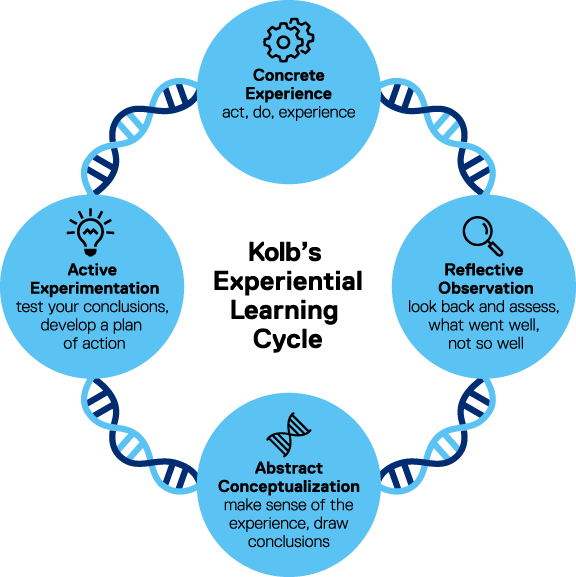
For my group’s Learning Blueprint topic, the psychology of social media, experiential learning aligns particularly well because social media is already embedded in many learners’ daily lives. Instead of teaching concepts such as social comparison, attention economics, algorithmic influence, or online identity solely through readings and lectures, learners can investigate these phenomena through their own interactions with social media platforms. This allows abstract psychological concepts to become personally meaningful and observable.
In a technology-mediated learning environment, I would design activities that encourage learners to critically examine their own social media use. For example, learners could track their screen time, document emotional responses to different types of content, or analyze how recommendation algorithms shape what appears in their feeds. They could then reflect on their observations through discussion posts, journals, or collaborative activities. Beyond reflection, learners could actively experiment with healthier digital habits, such as disabling notifications, setting time limits, or intentionally following more positive and educational content. By observing the effects of these changes on their attention, mood, and online behaviour, learners would not only understand psychological concepts but also apply that knowledge to improve their own digital well-being.
One of the strengths of experiential learning for this topic is that it encourages self-awareness and critical thinking rather than memorisation. However, it also requires careful design. Learners may have very different experiences with social media, and some may be uncomfortable sharing personal information. To address this, activities should emphasise voluntary participation, privacy, and reflection rather than requiring disclosure of sensitive experiences.
Overall, experiential learning provides a meaningful way to connect psychological theory to everyday digital experiences, helping learners move beyond understanding social media concepts in theory to recognising how those concepts operate in their own lives.
Kolb, David. (1984). Experiential Learning: Experience As The Source Of Learning And Development.
Quay, John. (2019). John Dewey’s conceptualisation of experience. 10.4324/9780429298806-7.
Toronto Metropolitan University. (n.d.). Kolb’s experiential learning cycle. Retrieved June 1, 2026, from https://www.torontomu.ca/experiential-learning/faculty-staff/kolbs-el-cycle/
Recent Comments